Company History
G.F. Manufacturing Co. / Kozy Manufacturing Company
Working draft. Here is what I’ve pieced together to share for the business history, as of May 2026, from written sources and oral history. Sources and a few gaps noted throughout.
Thomas Harry Godwin was born June 29, 1893, in Exira, Audubon County, Iowa.¹ He grew up on a farm in the area and worked as a carpenter and contractor, sometimes moving in with farmers while building their farmhouses. He served in the Navy during World War I, stationed in England,³ reaching the rank of Chief Quartermaster.² In 1919, still holding that rank, he demonstrated a Sperry Salvo parachute at Atlantic City before the Pan-American Aeronautic Congress, narrowly escaping death twice in the process.² He reportedly had some connection to Glenn Curtiss, the aviation pioneer, though the nature of that relationship hasn't been discovered yet.³ When exactly he was discharged from the Navy and the full nature of his service isn't established by any source in hand.
After returning from WWI, he expanded into larger contracting jobs — churches, schools, and other structures in western Iowa and northern Missouri.¹⁴ The 1920 census lists his occupation as house carpenter.¹ He married Eva Lulu Hay in Exira on June 10, 1920.¹
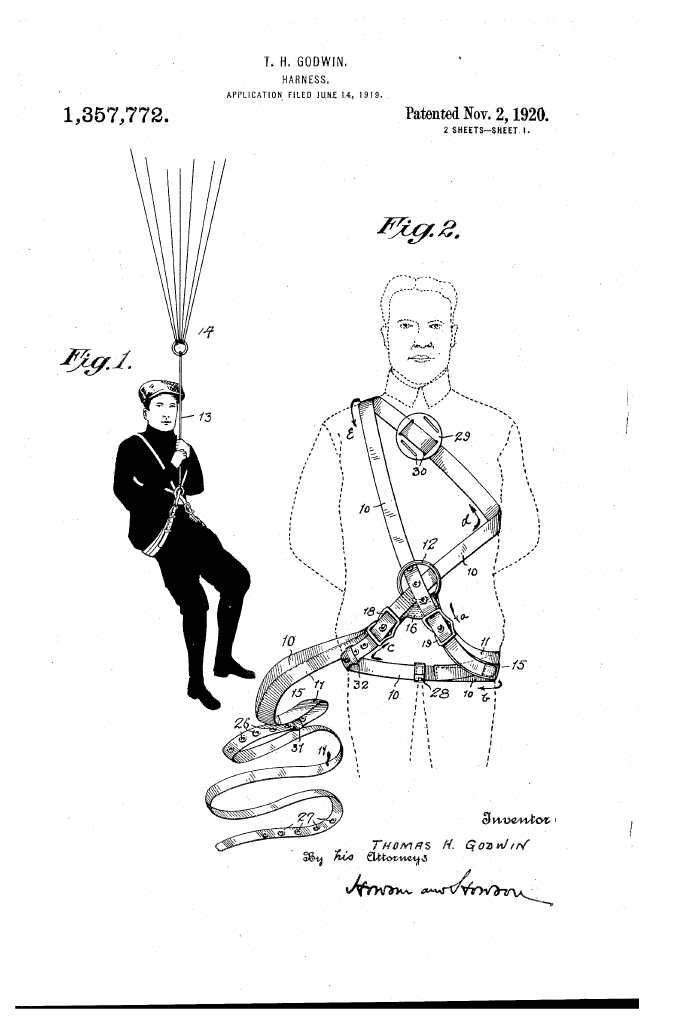
In 1919, Godwin filed a patent for an aviator's parachute harness designed to secure an unconscious flier during descent and allow quick release on landing.⁴ He retained Howson and Howson, a professional patent firm in Philadelphia, as legal representation, rather than a local Iowa attorney.⁴
According to his grandson, G.F. Manufacturing Co. was founded in Exira that same year. The first ledger entry, Tom A. Godwin recalls, reads: "2 mules and a wagon."³ What the "G.F." stood for hasn't yet been established.
The company later counted its origins to 1912, when T.H. would have been 19. A January 1945 advertisement in Wallaces’ Farmer headlined "Again — As for 33 Years…," implying a start date of 1912.¹⁵ In a 1968 interview, Thomas J. Godwin told the Des Moines Register that his father had started the business "about 1912 as a 19-year-old carpenter."¹⁴ No founding document has been located to confirm either date.
The Des Moines Register profile of the company also reported that T.H. had the idea to manufacture portable, prefabricated buildings and farm structures in order to keep his men busy through the winters. He got a start by building small chicken coops and displaying them at the state fair.¹⁴
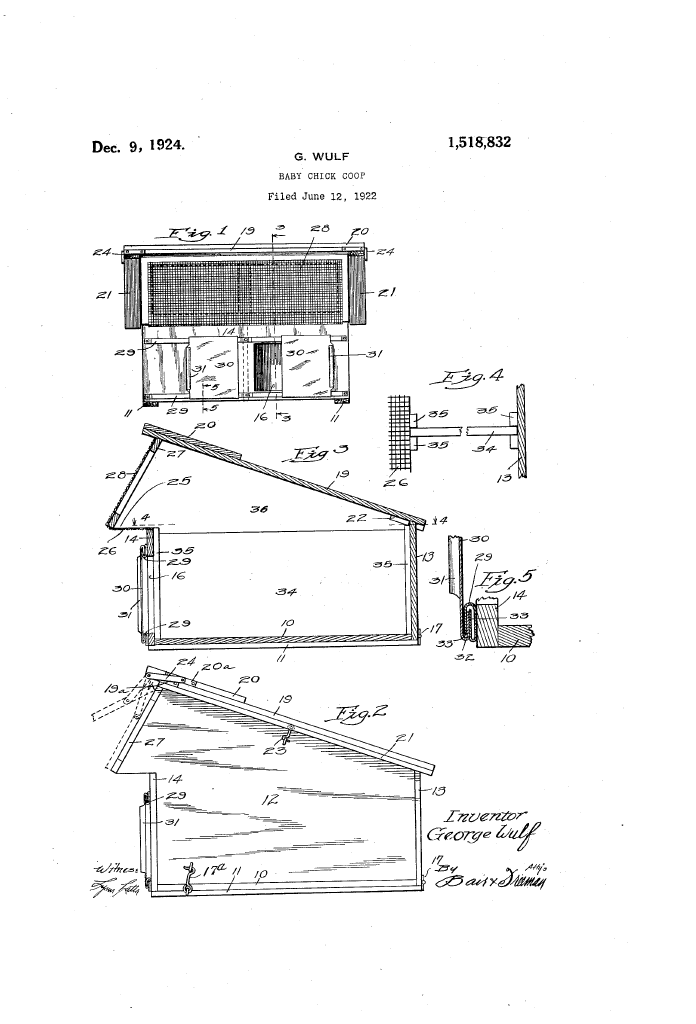
The early product line was indeed agricultural. This was a time of 80-acre operations, every one of them raising cows, pigs, and chickens. In 1922, Godwin and fellow Exira resident Benjamin F. Jensen each acquired a one-third interest in a patent for a portable baby chick brooder, invented by another Exira resident, George Wulf.⁵ The patent, filed June 12, 1922 and granted December 9, 1924, described a portable structure with a two-slope hinged roof, sliding doors, a removable interior partition, and an elevated floor base.⁵ Wulf held the remaining third. Who these gentlemen are, and the longevity of their relationship, are questions without answers at this time.
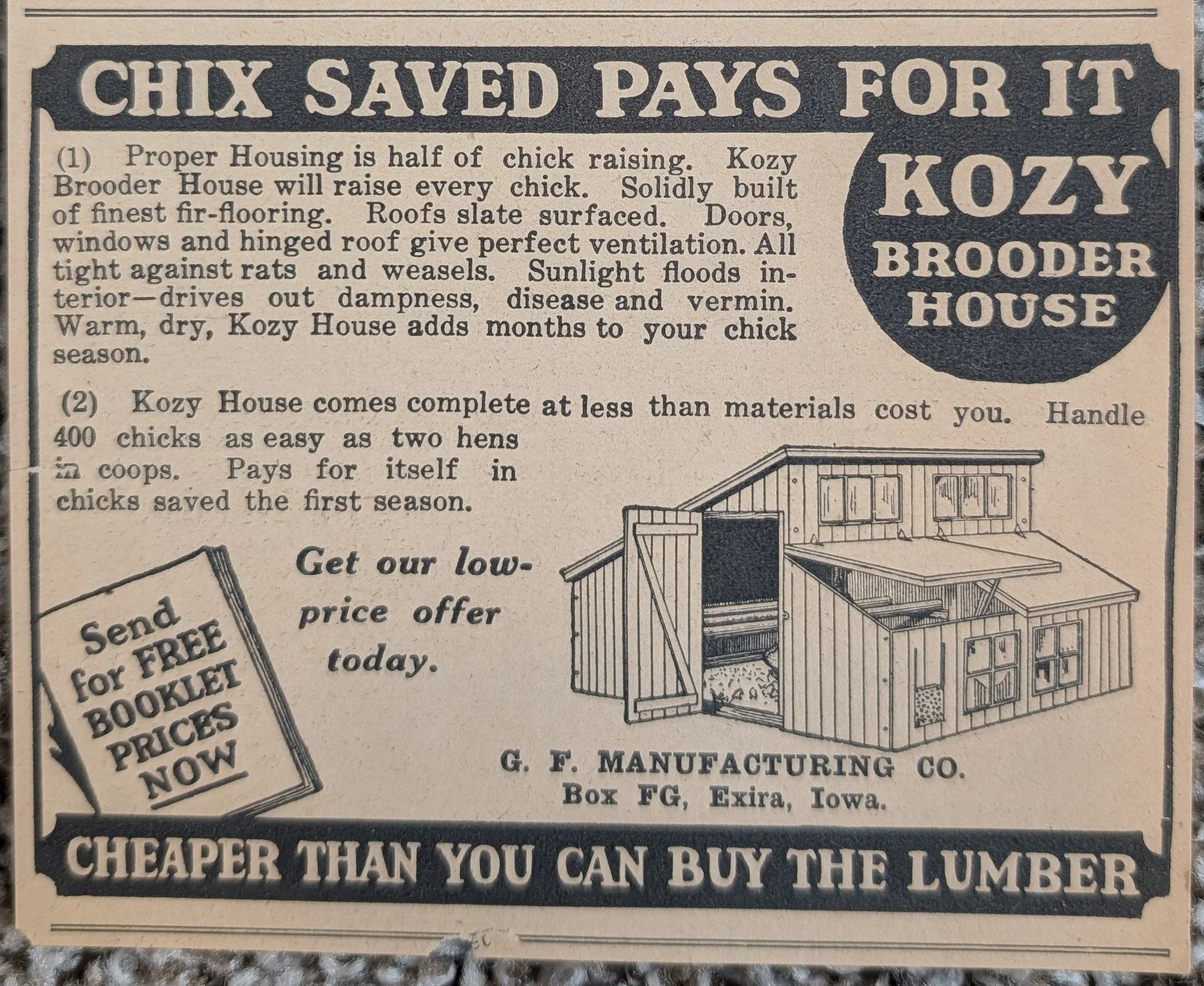
By February 1926, the company was advertising a Kozy Brooder House in The Indiana Farmer's Guide, the earliest dated piece in my personal physical collection, though almost certainly not the first advertisement the company placed.⁶ The copy read: "Comes complete at less than materials cost you." The manufacturer line identified the company as G.F. Manufacturing Co., Box FG, Exira, Iowa.⁶ A second brochure, undated, shows the company producing grain wagons alongside a broader line of farm outbuildings (hen houses, farrowing houses, corn cribs, garages) sold under the Kozy name, with Thomas Godwin signed as President.⁷
A trademark application filed September 7, 1926 lists the owner as Kozy Manufacturing Company and claims first use of the Kozy mark as April 1, 1922.⁸ The G.F. Manufacturing name appears on the 1926 advertisement; the Kozy Manufacturing Company name appears on the 1926 trademark filing. Whether these were parallel entities or a transition in progress isn't established by the record.
A full-page advertisement in Wallaces Farmer from January 6, 1945 confirms the company was still operating under the G.F. Manufacturing Co. name as late as that date, with Kozy as the product line rather than the company name.¹⁵ The rebrand to Kozy Manufacturing Company on the masthead occurred sometime after January 1945.
The Depression hit and froze prices. Farmers could only sell for so much, but inputs kept going up. New businesses could set their own prices.³ A consequential shift came from the customers themselves: people had started moving into the farm structures. Not because the company designed them for that purpose, but on their own initiative, converting chicken coops and hog houses into living quarters because housing was scarce and money was tight.³ It is unknown whether any livestock inhabited any of the specific residences prior to humans moving in. The company took notice of their buildings being used for human habitation.

A second federal trademark registration, filed November 29, 1946, claims first use of the mark in connection with structures for human habitation (houses, garages) as January 1931.⁸ Whether that date reflects an actual production shift or simply the point when the company first began formally marketing structures for human use isn't determinable from the trademark record alone. The oral history indicated that the idea came from buyers first.³
After the war there was significant demand for housing, and the company was producing residential structures.³ As an example of the pricing, grandson Thomas A. Godwin described two models of the signature curved-roof home: a one-bedroom at approximately $1,200 and a two-bedroom at approximately $1,600, though those figures are undated.³ The structures were shipped in knock-down sections and assembled at the point of use, per the language of the 1946 trademark filing.⁸ The buyer arranged the foundation; trucks arrived from Exira, and the crew assembled the structure in a couple of days. No flooring, no cabinets.³ The company's residential brochure described: "all lumber is cut to exact lengths, and entire sections are assembled in jigs, so they are perfectly square and true — then securely nailed."⁹
Lumber came directly from mills. Missouri oak from small operators in the Ozarks. Spruce-pine-fir from the Pacific Northwest, including Portland. All of it arriving by rail, stacked on both sides of the road at delivery.³ As mills shifted production toward pallets in later years, getting oak in long lengths (8, 10, 12 feet) became difficult.³ Thomas Harry and his son Thomas J. designed everything in-house; Tom A. Godwin recalls three drafting boards at home.³ The company ran its own printing press, and the equipment is reportedly still in the factory buildings.³ The workforce ran to 300 people across three shifts, 24 hours a day, with 7 secretaries in the office.³ ¹⁴
The company's growth had not been without setback. In 1921, a second factory opened in Council Bluffs, running several hundred workers across three shifts alongside the Exira operation. The entire business moved back to Exira in 1933 after the Council Bluffs plant burned.¹⁴
Thomas J. Godwin was born February 11, 1923, in Exira.¹⁰ He graduated from Exira Community Schools in 1940, attended Kemper Military School in Booneville, Missouri, then entered the United States Military Academy at West Point, graduating in 1945 with a Bachelor of Science in Engineering.¹⁰ He trained as a fighter pilot, flew P-51s, and was stationed at Clark Air Force Base in the Philippines.³ After his honorable discharge (year unconfirmed) he married Anita Atherton on June 27, 1948, and they made their home in Exira.¹⁰ He helped operate Kozy Manufacturing for the rest of his working life, his obituary says, "until Tom retired."¹⁰ The business continued after he did.
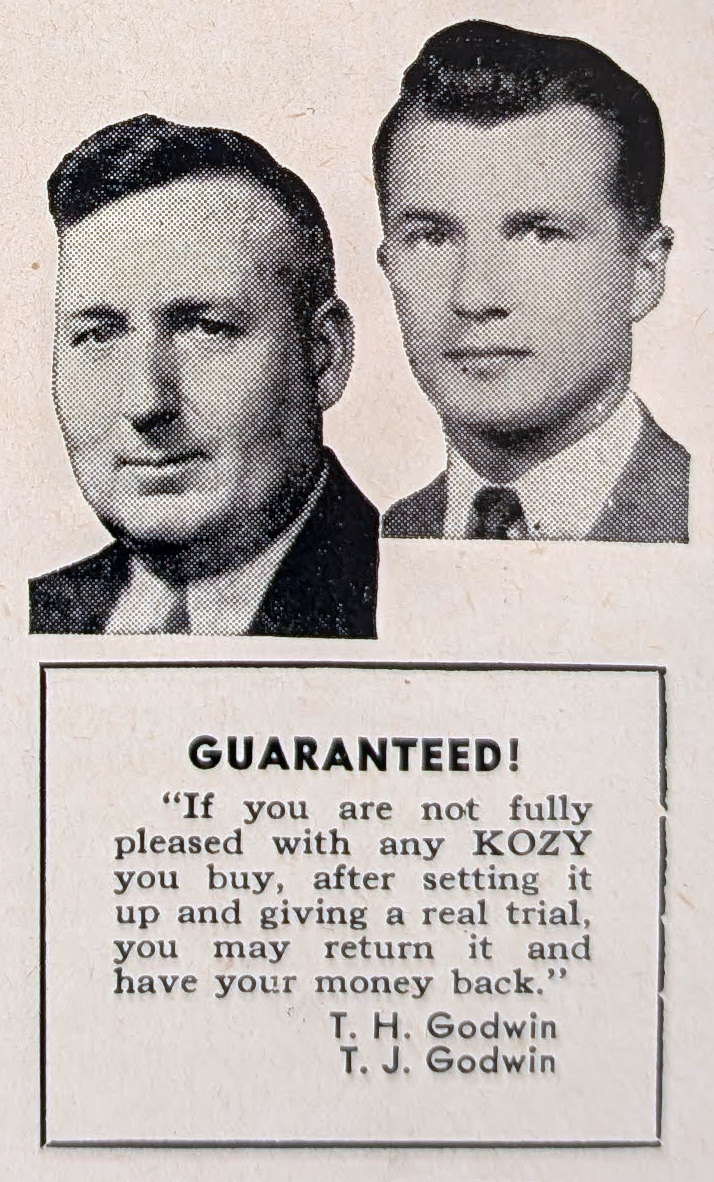
But before that, and by the 1950s, the company was said to be shipping to all 50 states and into Mexico and Canada.³ A February 1959 listing in American Builder describes the company's distribution radius as 500 to 700 miles, 24 basic plans available, package pricing from $2,000 to $11,000 f.o.b., delivery in ten to fourteen days, C.O.D. financing, no minimum order, and sales through builders and dealers.¹¹ A 1970 filing with the Interstate Commerce Commission shows Williams Truck Lines of Audubon, Iowa, applying for temporary authority to haul "portable- and permanent-type farm buildings" from Exira to points in Kansas, Missouri, North Dakota, South Dakota, Oklahoma, and Texas, with Kozy Manufacturing Co. named as the supporting shipper and Tom J. Godwin listed as president.¹²
By the late 1960s, the agricultural side of the business was hollowing out. Farming had consolidated (fewer operations, bigger units), and some of the buildings Kozy had built its reputation on were no longer in demand at all. Hen houses were giving way to large cage operations that a single 32-by-40-foot building could replace. “It's a spotty market for us,” T.J. Godwin told the Des Moines Register in 1968.¹⁴ The shift toward residential construction, which had started as an adaptation to buyer behavior during the Depression, was now also a response to the shrinking farm-building market.
Thomas Harry Godwin died January 19, 1963, at Audubon County Memorial Hospital, at age 69.¹³ His obituary identified him as "owner-founder of Kozy Manufacturing Company" and described the firm as building and distributing "pre-fabricated houses and farm buildings."¹³ He was buried in Exira Cemetery.¹
There is a bit of family wisdom worth recording and retaining. Locals around Exira tended not to buy Kozy products.
"Within a 50-mile radius, you're seen as an idiot. Outside 50 miles you're an expert,"
as the saying went in the Godwin household.³ One of their strongest dealers was in Sandwich, Illinois.³
Thomas A. Godwin, Thomas J.'s son, attended West Point in the 1970s during the Vietnam era and eventually took over the company.³ He shifted operations toward agricultural equipment manufacturing, taking on a large contract with Pax Feeders. When Pax went bankrupt, the fallout was severe: eight years focused on hog feeders had cost the company its dealer network, its home-building equipment, and most of its experienced employees.³ He attempted custom home production in the later period, but found the labor demands of custom work incompatible with what remained of the operation.³
The company wound down active production. The exact date isn't confirmed. Tom A. kept a longtime Kozy secretary employed during the wind-down — she had started with the company at age 19 — and had her shredding documents to stay busy, even as her memory was failing.³ The remaining records, stored in the old factory buildings, had gone wet and moldy from moisture, mice, and decades of neglect. "Like opening an Egyptian burial vault," is how Tom Godwin described it.³ The EPA continued visiting the site for six years after production stopped, monitoring lead paint and drainage.³
A federal trademark registration filed in 2007 shows Kozy Manufacturing Company still operating out of a P.O. Box in Exira, with a Chicago intellectual property firm retained to maintain the mark.⁸ The second registration, filed in 1946, had been renewed twice, in 1968 and again in 1988, before eventually lapsing.⁸ The 2007 registration was cancelled in 2014, not because of any challenge or dispute, but because a routine maintenance declaration was not filed.⁸ The company has never formally dissolved. Tom A. Godwin retains the land, the factory buildings, and the family home in Exira.³
Thomas J. Godwin died August 15, 2019, at the age of 96.¹⁰
-
FamilySearch biographical summary, Thomas Harry Godwin (familysearch.org); 1920 U.S. Census
Daily Capital News clipping, c. 1919 (parachute demonstration at Atlantic City)
Thomas (Tom) A. Godwin (grandson of Thomas Harry Godwin), oral history interview, April 17, 2025 Thank you, Tom!!
U.S. Patent 1,357,772 (Aviator's Harness), filed June 14, 1919; granted November 2, 1920
U.S. Patent 1,518,832 (Baby-Chick Coop), filed June 12, 1922; granted December 9, 1924
Kozy Brooder House advertisement, The Indiana Farmer's Guide, February 6, 1926. Acquired via eBay
G.F. Wagon Boxes / Complete Kozy Line brochure, G.F. Manufacturing Co., Exira, Iowa. Undated. Acquired via eBay
USPTO Trademark Records, Registration Nos. 226350 (filed Sep. 7, 1926), 439051 (filed Nov. 29, 1946), and 3414123 (filed Apr. 10, 2007)
Kozy residential homes brochure ("enjoy luxury living in your own beautiful KOZY home"), Kozy Manufacturing Company, Exira, Iowa. Undated
Thomas J. Godwin obituary, Kessler Funeral Home, Exira, Iowa, August 2019
American Builder national home manufacturers directory, 1959. Located via USModernist Archives
Motor Carrier Temporary Authority Application No. MC 134402 TA, Federal Register, Vol. 35, No. 56 (March 21, 1970), filed March 12, 1970. Supporting shipper: Kozy Manufacturing Co., Exira, Iowa (Tom J. Godwin, president)
Thomas Harry Godwin obituary; Iowa death certificate
Thomas K. Godwin, interview by Arlo Jacobson, "Building a Home? Exira Firm Will Provide Parts," Des Moines Register, July 21, 1968, p. 67.
Advertisement, Wallace's Farmer, January 6, 1945. G.F. Manufacturing Co., Exira, Iowa.
